


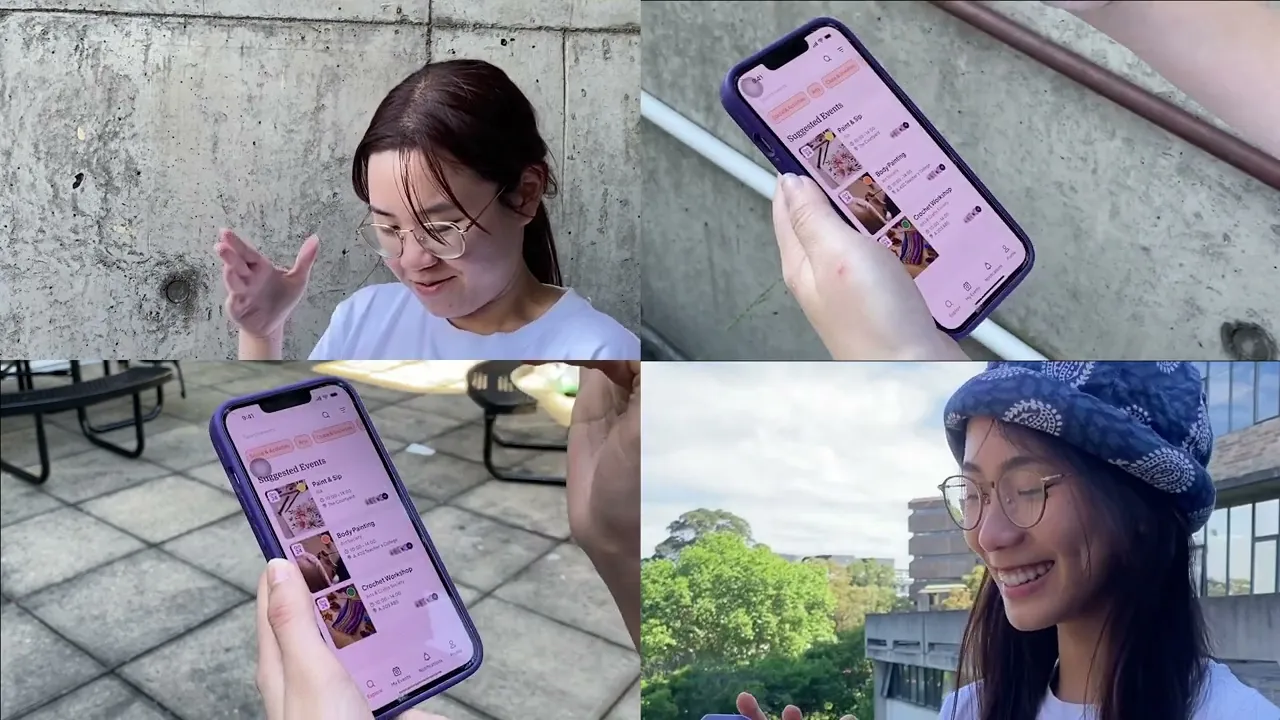
Sparkmate
Making it easier for students to build connections by redesigning event participation
Product design · Wearable tech
Overview
SparkMate is a mobile app paired with a wearable bracelet that helps university students discover and register for campus events, then turn them into lasting connections in person. It was my university capstone project inspired by UN SDG 3, Good Health and Wellbeing.
Problem statement
Student loneliness is one of the most common and least visible challenges at university, and one that tends to deepen the longer it goes unaddressed. Campus initiatives to help already exist, yet many students still struggle to turn an opportunity into a connection that lasts. SparkMate is built to close that gap.
My Responsibilities
Competitive analysis of seven existing solutions, mapping where the market fell short.
Primary research through surveys, interviews, and focus groups.
Affinity mapping and two user personas to turn the research into design decisions.
Concept ideation and evaluation.
Visual design of the event discovery and registration experience, including the Group Request feature.
Promotional video, directed and edited to communicate the concept.
Timeline
Aug - Nov 2024
Team
4 members
Tools
Figma
Figjam
Framer
Adobe AE
& Premier Pro
💡 Note: All final designs in this case study have been updated since the original 2024 project to reflect my current UI skill and judgement.
Context
University can be a surprisingly lonely place.
Particularly during periods of transition such as entering university or studying away from existing support systems. And when that isolation continues, it can affect more than someone’s social life, including their wellbeing and engagement with university.
(Beutal, 2016)
(Zahedi et al., 2022)
(Beutal, 2017)
Process
Starting with students and refining through evidence
We used design thinking as a flexible framework to guide the project from research through to testing. Each cycle helped us stay close to student needs, challenge early assumptions and refine the concept as new evidence emerged.

Market analysis
Existing solutions lack integration, sustained support, and accessible engagement
Despite several existing solutions on the market like Bumble BFF, Umii, peer mentoring, and orientation programs, many students still struggle to form lasting connections. To understand what are their current strengths and weaknesses in supporting the friendship-building journey, I conducted competitive analysis and positioning map of seven solutions and found three gaps:
While the market analysis revealed structural gaps, it wasn’t enough to assume these were the real barriers. The question that we needed to answer next was:
Do students experience these gaps the same way, and what do they actually need when forming meaningful connections?
Research & Insights
From market gaps to lived experience
To answer that question, we used a triangulation approach, combining three methods: surveys, interviews and focus groups so the findings could cross-check each other.
Four key insights
Then, we synthesised everything in an affinity diagram in FigJam, clustering quotes and notes until four insights held steady across all three sources.
Social uncertainty discourages initiation
Students hesitated to start friendships in unfamiliar situations.
Connection still felt self-driven
Even with programmes available, students feel it’s on them to make it happen.
Structured group activities reduce social pressure
Shared, in-person activities make connection feel more natural than one-on-one chats.
Compatibility signals matter early
Shared interests and matched energy help students feel safe investing in a connection.
Together, these insights revealed that the issue was the emotional and social friction involved in turning opportunity into meaningful connection rather than a lack of opportunities. This led us to our problem statement:
The challenge wasn't creating more opportunities
Students have access to social opportunities, yet still feel hesitant and personally responsible for forming meaningful friendships. Existing solutions don’t sufficiently reduce the social friction of initiating and sustaining connection.
Even with lots of opportunities, it still feels like I have to put myself out there and make the first move 🥲
Agree
I think matching energy and vibes also matters. Without that, it’s hard to build friendships 😓
How might we create strategies that support students at every stage of connection-building, through interest-based activities to foster lasting friendships?
Personas
Design for two students hitting the same wall from opposite sides
We turned the research into two personas and used them as reference points throughout ideation. Their situations were different, but both faced the same problem: the effort of starting and maintaining a connection fell largely on them.

Mimi Zheng
19 yo, First-year International student
Mimi wants to make friends at university, but shyness and a language barrier make unfamiliar social settings intimidating. She often exchanges contact details without making plans. Welcoming, low-pressure activities would help her turn first conversations into genuine connections.

Aaron Luong
22 yo, final-year student
Aaron has friends and is open to meeting more people, but a busy schedule and long commute make it hard to show up consistently. His challenge is sustaining connections beyond a first meeting. He needs easier ways to keep in touch and organise plans that fit around his studies.
Ideation & Early concepts
What we got wrong first
We used Crazy 8s and brainwriting to explore possible directions, then compared the strongest ideas using a weighted decision matrix. Our first take on that direction still leaned on one-on-one matching and location tracking, the features that feel obvious for anything social.
However, peer critique and a second look at our research showed problems with both concepts. Location tracking raised privacy concerns, and one-on-one matching went against our finding that students connect more easily in groups. This was a call for us to work out what the experience needed to do before jumping to the features .

Concept 2: Bracelet locating same event attendees
Privacy concerns with location- tracking
Design strategy
Refocusing on requirements
Instead of starting with features, we mapped our research insights to clear requirements. Any solution had to:
Bring students together through shared activities (reduce conversation pressure)
Work in group settings, not just one-on-one situations
Keep connections going after the first meeting
And that brought us to….
Solution
Sparkmate
A mobile app with a wearable bracelet to support students through every stage of social connection, from discovering events to building lasting friendships.
Reduce anxiety by joining events as a group
Users join or create groups to attend events together. The bracelet displays the group’s color and name, making it easy to find each other, reducing the feeling of exclusion students described in research.
Managing all events hosted by users and the university
The ‘My Events’ screen provides users with a space to manage all their events within the app. Users can view events they’ve joined, check groups they are a part of, browse saved events, and even create their own events.
Celebrate social milestones
Rewards for social milestones celebrate progress and encourage long-term connections. Repeated connections trigger unique visual effects on the bracelet, reinforcing the meaning of each friendship.
Exploration & key iterations
Making Group Request sequencing visible
Group Request was the hardest feature for users to understand, they couldn’t tell what actions were available or in what order, leading to dead ends with no explanation.
“I don’t know if I can join a group before registering an event because I would want to be in a group first.”
User 1
I explored a few directions before landing on two buttons with clear states due to time constraints. Between 2 options, informal testing reported better understanding and intuitiveness with the latter.


Option 1
Single Register button
Error popup guided users when they attempt to create a group before registering.
“Request a Group” as a term was confusing.
Forced individual registration for the event before group registration i.e. longer steps.
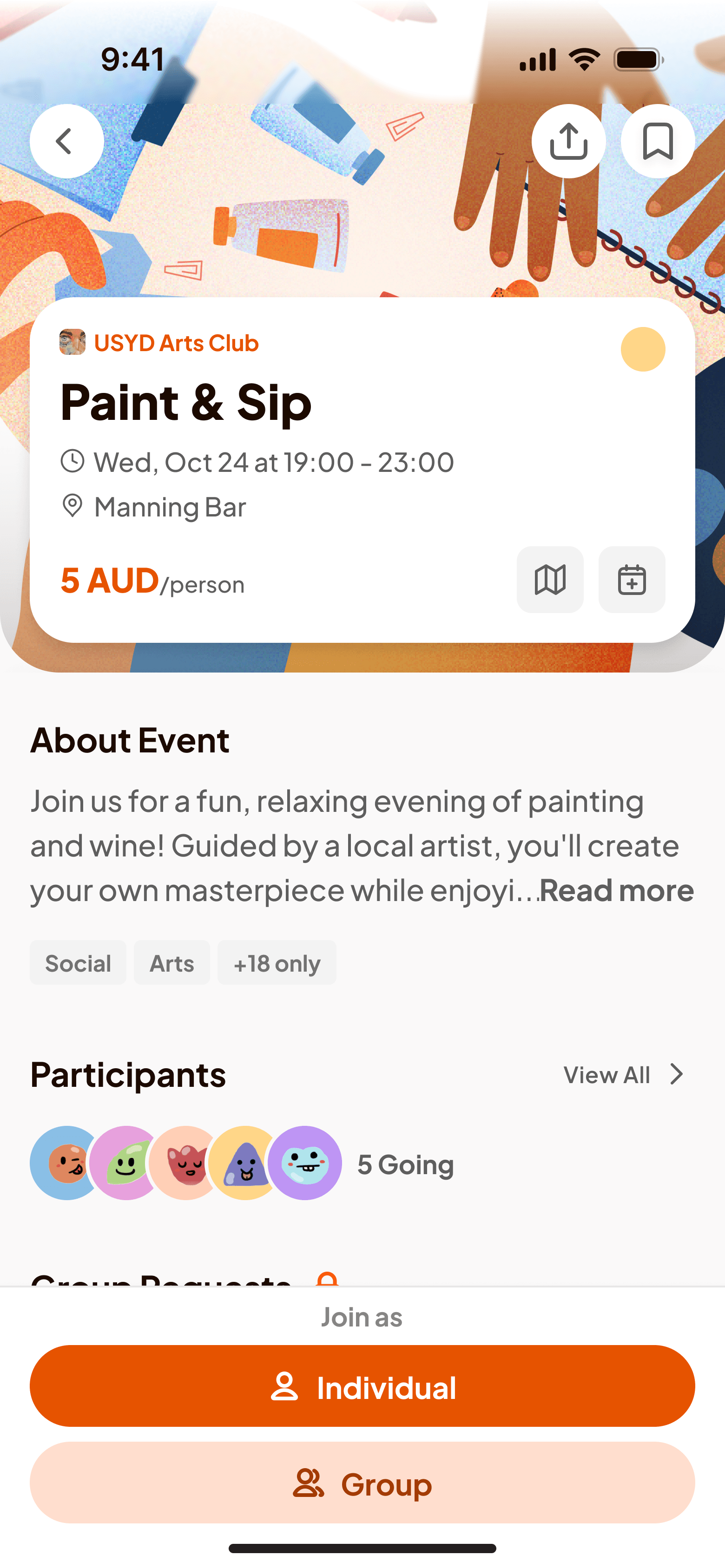

Option 2 (Final direction)
Two visible registration paths
Plain language describes both registration options upfront.
Parallel flows - each path triggers its own popup, removing the forced linear sequence.
Wordy confirmation to inform next steps might make users experience fatigue and miss important actions.
Closing the gap between app and bracelet
A recurring theme was that the bracelet felt like an accessory rather than part of the experience. The fix was making the connection visible in the app.


Impact & success metrics
Early validation
Two rounds of testing and external recognition gave us early confidence that SparkMate was moving in the right direction.
86.5
SUS score confirmed strong usability after 2 rounds of testing.
Users responded positively to the bracelet concept and connection-building features
Shortlisted for University of Sydney Architecture, Design and Planning Industry Award

Success metrics
SparkMate is still a concept, but if it were to move into development, success would need to be measured beyond usability, specifically whether it actually reduces loneliness over time. These metrics include:
Active users and retention rates over a semester
Reduction in loneliness via pre- and post-use surveys
Event participation and average connections made per user
Usage of key features like Group Requests and Icebreakers
RETROSPECTIVE
Some learnings along the way
Pivoting based on research, not assumptions
Our early concepts felt right, one-on-one matching seemed like an obvious solution for a social platform. But when we actually listened to what students told us, it contradicted almost everything we’d assumed. While that was uncomfortable, it led us to a much better solution. I came away with a stronger conviction that research should challenge your instincts, not just validate them.
Designing for the messy middle
The hardest part of this project for me was designing for the awkward moment in between, where students know they should connect but have no idea how to start. I spent a lot of time thinking about that specific feeling of hesitation, and it shaped features like bracelet tap and icebreakers more than anything else. Designing for discomfort instead of just the ideal scenario, made the solution feel genuinely useful rather than optimistic.

